I’m a big fan of Chris Brennan (is any astrology lover not?), particularly his seminal work, Hellenistic Astrology: The Study of Fate and Fortune. From memory, this piece of work brought to life for me the idea of astrology as a ‘language’. It was reading his book that introduced me to the writings of Francesca Rochberg. It’s such a simple idea, but it was a penny-drop moment that blew me away at the time. I had never really thought of it that way.
Quite often, I’d heard or seen the phrase ‘it speaks to me’. I’d never given the phrase much thought and assumed it was figurative, but it is, in fact, quite literal. In Ancient Mesopotamia, reading the sky was reading and translating the sacred language of the gods.
The gods were speaking, and if you learned their language, you could listen to their message. American assyriologist and science historian Francesca Rochberg notes that the ancients referred to this as ‘Heavenly Writing‘. A means by which the gods spoke to humans.
Like any language, how you learn and listen is central to true understanding. For example, you could pick up a French dictionary and translate a paragraph of text, but your translation would be, at best, lacking and, at worst, completely inaccurate.
You need to know the grammatical rules and conjugation, the context, and all the idiosyncrasies of the language to understand correctly. And even then, sentences can sometimes be cryptic, requiring thought and interpretation beyond a literal translation.
“The stars are like letters that inscribe themselves at every moment in the sky. Everything in the world is full of signs. All events are coordinated. All things depend on each other. Everything breathes together.”
― Plotinus
Divine Scripts
The Ancient Mesopotamians saw astrology as an intellectual discipline, integral to society, and nothing like the pseudoscience it is viewed as today. Messages, in the form of divine scripts from the gods, were necessary for strategic planning. It was a form of divination, the term for any practice that seeks knowledge of the divine will or hidden truth through signs, symbols, or rituals).
The scripts appeared in the form of planetary locations and were celestial omens. Astrologers translated these into what we understand as simple conditional IF statements. For example, eclipses were bad omens. If an eclipse occurs, then the king will die. If Venus is in retrograde, then harvests will fail.The first part of the statement that describes the celestial event was called the protasis, and the predicted earthly consequence was called the apodosis.
“When in the month Ajaru, during the evening watch, the moon eclipses, the king will die. The sons of the king will vie for the throne of their father, but will not sit on it.”
Ancient astrologers did not see the movement of the planets as causal. It wasn’t that the eclipse caused the impending death of the king. It was an indication or a sign of something that would happen. Which leads to thinking it could have been avoided if the right action had been taken.
I have been thinking about where we see translations of divine language playing out elsewhere and wondering why we accept one divine truth over another in the absence of scientific evidence? For example, why do we accept that the Bible (or any sacred text) is God-breathed, and up to us (or the Church) to interpret?
Parallel Sacred Languages
The idea of a divine or sacred language, where symbolic systems convey truths about the universe and humanity’s place within it, exists in many traditions.
In astrology, it is believed that the gods spoke, and man transcribed the words and their meanings. This is not too distant from the Christian concept of the Logos. Often translated as ‘The Word’. (‘In the beginning was the Word, and the Word was with God, and the Word was God”. (John, 1:1).
Kabbalah
If we think about Kabbalah, for example, the letters of the Hebrew Alphabet are considered tools of creation in themselves.
Kabbalah is a mystic part of the Jewish Tradition that explores the hidden truths about the relationships between God and humanity.
In Kabbalah, the letters of the alphabet are much more than symbolic writing but are seen as living forces, bridging the finite human world with the infinite divine world.
As God created the world through speech, each letter is a building block of life and creation. So when a kabbalist studies the letters, they are not only reading and interpreting the letters but directly engaging with the divine.
Like astrology, Kabbalah translates the symbols, but it also goes much further as a participatory ritual, directly connecting to the source as part of the reading process.
Sacred Geometry
And then we have sacred geometry. It is described as the ‘geometry of consciousness’ and the ‘pattern of creation’ from which everything in the universe comes out.
This, too, is presented as a visual language that helps us understand where we have come from, where we are now, and where we are going.
Many traditions see everyday life’s visual and geometric patterns as the language of the universe, like the divine architecture of all earthly things.
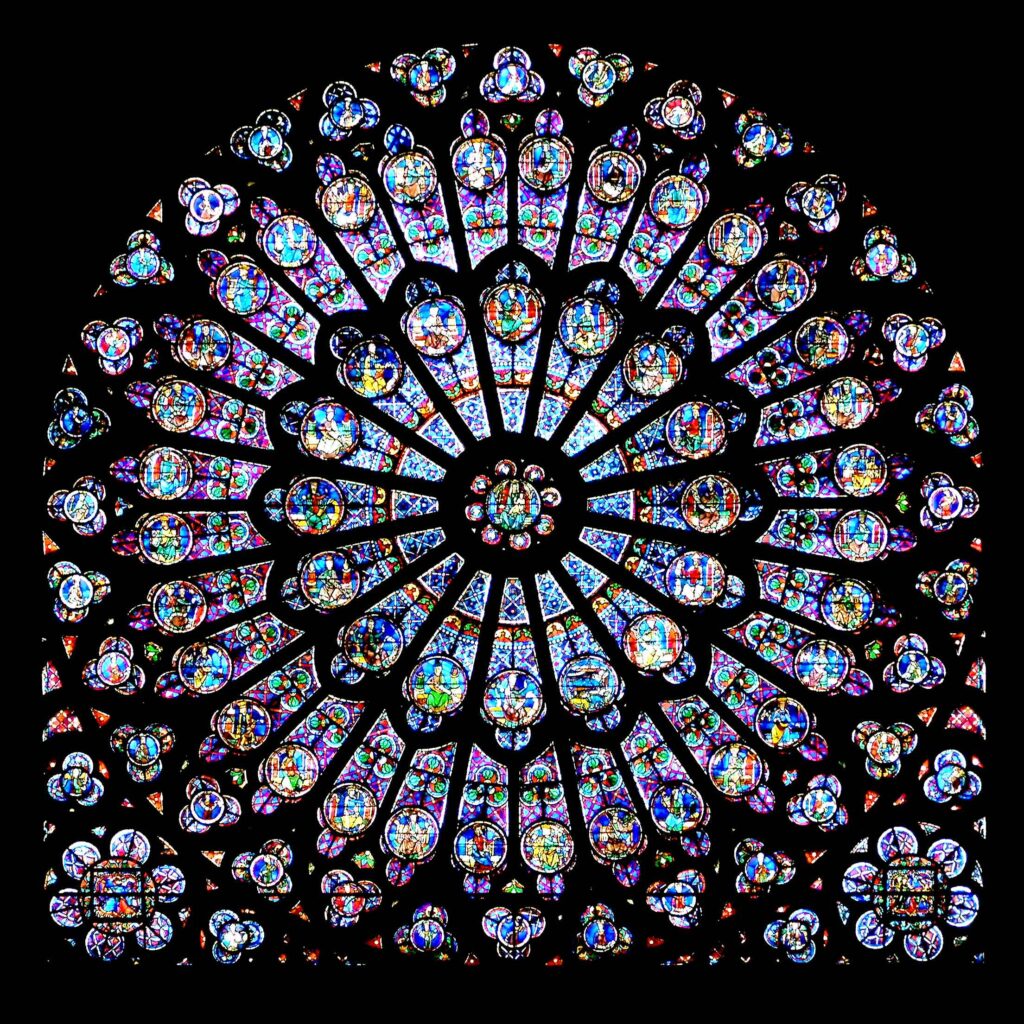
Sacred Geometry – By Krzysztof Mizera, changed by Chagler and MathKnight – Based on File:Rozeta Paryż notre-dame chalger.jpg, CC BY-SA 4.0, https://commons.wikimedia.org/w/index.php?curid=7908267
All of these remind us of the inescapable human need to search for hidden meaning and messages from the divine.
Astrology is an Art, Not a Science
When I began my training as an RE and Philosophy teacher (high school), I became much more attuned to modern attitudes towards belief systems. Many, particularly in the West, think the ancients believed in astrology because they lacked science to help them understand otherwise. This is a false assumption. In the introduction of Ptolemy’s Tetrabiblos, he writes:
“Of the means of prediction through astronomy, O Syrus, two are the most important and valid. One, which is first1 both in order and in effectiveness, is that whereby we apprehend the aspects of the movements of sun, moon, and stars in relation to each other and to the earth as they occur from time to time; the second is that in which by means of the natural character of these aspects themselves we investigate the changes which they bring about in that which they surround”.
There is a clear recognition that the measurement of the movement of celestial bodies is wholly separate from the process of interpreting meaning. He goes on to say:
“The first of these, which has its own science, desirable in itself even though it does not attain the result given by its combination with the second, has been expounded to you as best we could in its own treatise2 by the method of demonstration. We shall now give an account of the second and less self-sufficient method in a properly physical way so that one whose aim is the truth might never compare its perceptions with the sureness of the first, unvarying science, for he ascribes to it the weakness and unpredictability of material qualities found in individual things,3 nor yet refrain from such investigation as is within the bounds of possibility when it is so evident that most events of a general nature draw their causes from the enveloping heavens”.
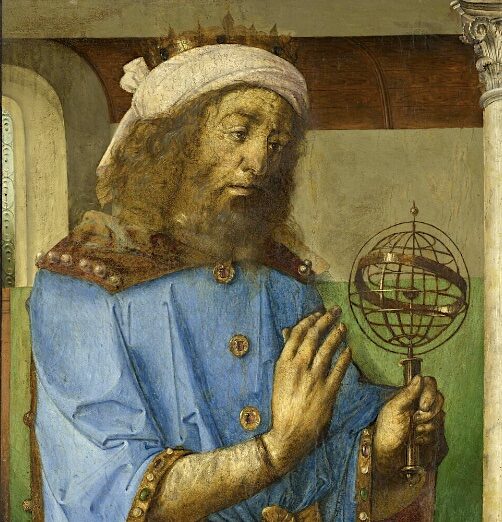
Ptolemy with an armillary sphere model, 1476. Public domain. Image via Wikimedia Commons.
He is essentially saying, ‘we know astronomy is precise and logical, but Astrology isn’t like that. It’s trickier because life is chaotic. However, he says that this doesn’t mean astrology isn’t worth studying, like any other art form that communicates and gives meaning.
Even if it’s not as perfect as math, it can still tell us a lot because so much of life clearly reflects what’s happening in the sky.
Historical practitioners were actually quite sophisticated in their understanding. Ptolemy clearly distinguishes between the scientific precision of astronomy and the interpretive art of astrology.
There are many reasons why some take astrology less seriously, than the examples noted above, which I will save for another post.
But, I found Chris Brennan’s Hellenistic Astrology highly thought-provoking. You can pick up a copy on Amazon, I can’t recommend it highly enough.
Just as Brennan revived Hellenistic astrology, perhaps we should all revisit these ‘sacred languages’ with fresh eyes.
Jo is a Religious Education and Philosophy teacher-in-training, with a PgDip in Sustainability and Ethics (University of Wales, Trinity St David) and DipHE in Moral and Philosophical Studies with Religion (University of the Highlands and Islands). Alongside her academic journey, she has spent many years immersed in the study of mythology, and astrology’s history and methods, blending scholarly rigour with a love for celestial traditions. She is currently working towards a Diploma in Astrology with the Mayo School in London. Her writing explores the meeting place between ancient belief systems and cosmic wisdom, reflecting on the search for meaning across time.