This is a long-form post and detailed exploration of Jupiter Symbolism in Astrology. If you want the super quick version of what Jupiter represents, click here!
When I first began learning astrology, and going beyond my basic Sun sign, one of the most interesting, and frankly mind-blowing placements (for me, anyway) I found in my birth chart was Jupiter.
My Jupiter is in Aquarius in the 12th house conjunct the Ascendant, (i.e. in very close proximity to) along with trine aspects to Saturn, Uranus, and Pluto. (If you’re new to astrology, much of this won’t make sense, but I’ll do another post with a link to fully explain the implications of all this).
I found the complexity of mapping out what this meant not only fascinating but one of the most telling and significant pieces of my chart. So many of my past experiences began to slot quickly into place.

You can check your own Jupiter placement by creating your own completely free birth chart.
I was expecting all my action to be in my Sun, Moon, and my inner planets, but found myself surprised by how much I couldn’t stop digging more and more deeply into Jupiter and its significations.
This post is a general introduction to Jupiter and its significations, or meaning, in a birth chart.
Jupiter Mythology and Meaning
When we are thinking about what any planet symbolises in astrology, I always find it useful to consider their mythological origins.
If you understand the myth, you understand the ‘why‘ Jupiter is interpreted this way in astrology. Otherwise you are just memorising words associated with Jupiter, which is fine if that works for you, but personally, I find the learning sticks more when I know the why!
In ancient times, many of our ancestors believed the planets were gods, and we could understand and interpret the sacred language of the gods by their placements in the sky.
The god associated with the planet (and often many details of their backstory), help us to understand what we mean astrologers say things like ‘He is very Jupiterian’, and so on.
In Roman mythology, Jupiter is the king of the gods and their protector. He is the Roman equivalent of the Greek god Zeus, described as the highest and powerful among the immortals, whom all others obey.
Both were considered kings of all the other gods, rulers of the sky and thunder, and held the highest authority in their respective pantheons. Due to their highest status in the hierarchy, they represent power, law, order, and divine authority. Jupiter symbolism reflects their place at the top of the cosmic tree.
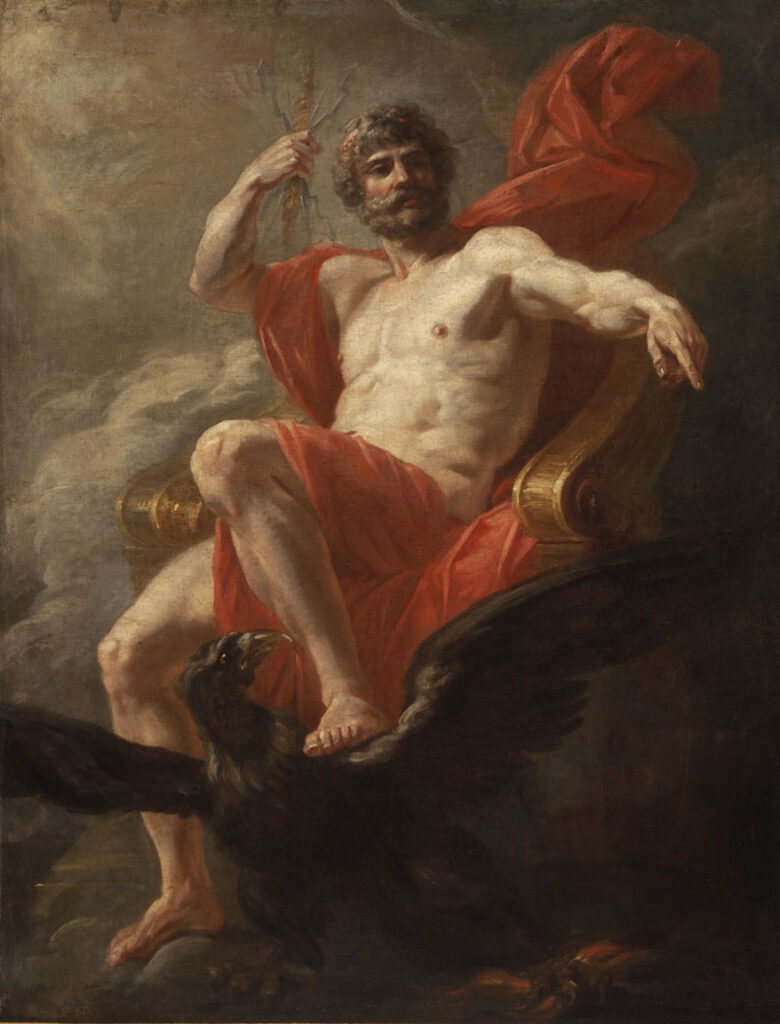
In Astrology, Jupiter is the founder of kingly power, law, and order, with the goddess of Justice (Dice), goddess of Custom and Tradition (Themis), and the goddess of Retribution (Nemesis) as his faithful assistants.
As Jupiter is strongly associated with the sky and thunder, his most distinctive attribute is the stylized lightning bolt, which he wielded like a javelin.
Like many Indo-European religions, the supreme deity was associated with the sky, storm, and light. The thunderbolt symbolized divine intervention, swift, powerful, and impossible to ignore. It was the big guy stepping in.
The myth of Jupiter/Zeus, usurping his father Kronos (the Roman Saturn) includes Jupiter’s creation of the first bureaucracy by employing his children and siblings to manage cosmic affairs, suggesting Jupiter’s supreme role in structuring and expanding systems. Jupiter is the CEO of the cosmos, or at least, the CEO that we would like to have.
What Does the Mythology Tell Us About Jupiter In Astrology?
Like his supreme role in mythology, Jupiter is a towering figure, recognized universally as the planet of luck, flourishing, and wisdom. Like all planets, Jupiter is expressed through the planetary placement in both the Zodiac, the house, and its aspects with other planets.
Over centuries, astrologers have referred to Jupiter, quite consistently as one of the two ‘Greater Benefics’ (the other is Venus). Astrologers believe its influence is that which brings good fortune, abundance, and beneficial outcomes. The better the planetary placement, the better the outcome.
From an ancient astrology perspective, Jupiter is considered one of the most inherently positive planets.
When Jupiter has a ‘strong’ placement in your chart, you are significantly more likely to be optimistic, generous, and have an adventurous outlook. It prompts individuals to strive towards greater states of being. Again, I will write another post on what it means to have a ‘strong’ placement for Jupiter (and other celestial bodies).
The Jupiter Glyph and it’s Meaning
I’ve seen varying descriptions of the Juplter glyph, so I will summarise these below.
The glyph, or symbol, for Jupiter (♃) is a stylized representation that carries both mythological and symbolic meaning.
It looks like a curved number “2” with a crossbar. It’s composed of:
- A crescent (☽) — symbolizing spirit, soul, or receptivity.
- A cross (✝︎) — symbolizing matter, form, or the physical world.
The crescent rising above the cross is understood to represent the spirit rising above matter, or the soul’s aspiration toward higher knowledge and expansion, aligning with Jupiter’s role as the planet of wisdom, growth, and belief.
It can also be seen as a symbol of benevolence and largesse, with the open crescent indicating openness to the divine or to broader perspectives.
Some interpretations link the glyph to Zeus’ lightning bolt, stylized into a symbol of authority and divine communication, while others view it as a staff or sceptre (a kingly emblem), fitting Jupiter’s mythic role as the king of gods.
I have also seen it referred to by NASA as a hieroglyph of the Golden Eagle, or Jove’s Bird.


Here are some of the key significations, or associations, of your Jupiter Placement.
What Does Jupiter Represent in Astrology?
Jupiter Symbolism – Expansion and Growth
This is Jupiter’s core principle. Jupiter symbolises the impulse to expand, grow, ascend, and progress, leading to abundance and the creation of larger entities or perspectives. Jupiter makes things bigger and greater. This seems a little bit abstract on it’s own, so I have broken down a few examples of how this Jupiterian enlargement can manifest in real life.
At the heart of it, this is about going beyond current limitations. It goes beyond just dreaming big, into moving into bigger territory, and this can take many forms, depending on which of the 12 astrological houses it is situated in, its planetary aspects (the angles it makes with other planets).
Career flourishing. Jupiter transits (the new position of a planet as it moves through the zodiac) often coincide with promotions, new business ventures, or increased visibility. Think about someone launches a side hustle that becomes a full-time enterprise under a Jupiter return. When Jupiter hits the 10th house (career/public life), it’s common to see an individual take on a leadership role or amplify their professional reach.
Educational Growth – Enrolling on a course, maybe at university, learning a new language, starting a PhD, or even taking a sabbatical to study something in depth and examples of Jupiterian growth and expansion. This is growth through knowledge acquisition. Not in the abstract sense, but in tangible commitments to long-term learning.
Physical Growth or enlargement. This can be literal, such as expanding your home, buying land, moving abroad. When Jupiter is transiting the 4th house, people often upgrade or expand their living space. With Jupiter in the 1st, it can manifest as literal, physical largeness, such as gaining weight, or something intangible such as projecting a bigger personality or presence.
Social and Network Broadening. In this area, Jupiter represents making new contacts, joining global communities, increasing influence online. Think of someone starting a blog or podcast during a Jupiter return that gains a large following. Jupiter is sociable. It doesn’t just want more, it wants to share more with more people.
Wealth and Financial Growth. Jupiter symbolises luck and abundance, meaning it brings financial opportunities, especially when linked to the 2nd, 8th, or 11th houses. Transits may result in a raise, a windfall, a wise investment, provided you’re acting with integrity and foresight (Jupiter rewards ethical action).
Growth of Perspective. You move from local to global thinking. You might go from worrying about your block to thinking about your country, or even the planet. This can show up as becoming more politically engaged, more involved in advocacy, or simply more conscious of interconnectivity.
The Shadow Side of Jupiter’s Growth
It’s worth noting that not all growth is healthy. Overexpansion can lead to burnout or overwhelm. Think of a business growing too fast and collapsing under its own weight.
Jupiter lacks boundaries and it can bring too much of a good thing.
Excess optimism can blind someone to risks (especially if Neptune’s involved).
Physical growth = weight gain or health issues if there’s indulgence (especially when Jupiter hits the 6th house or aspects Venus).
Jupiter Symbolism – Wisdom, Philosophy, and Higher Education
Jupiter is deeply connected to the pursuit of meaning and the development of a comprehensive worldview. It represents scholars, legal experts, judges, sages, philosophers, writers, and academics. It governs the higher education system, colleges, and universities, signifying both students and teachers and their endless search for truth. Acquiring deep wisdom and knowledge about topics is a key Jupiterian trait.
I’ve broken this down with some examples:
The Search for Meaning – Jupiter governs our desire to understand the bigger picture. This is more than basic curiosity, it’s the compulsion to ask the bigger life questions such as, Why are we here?, What is the purpose of life? What do I believe in?
This is the philosopher’s drive, whether formal or informal.
Perhaps someone hits a midlife crisis (say, at their Jupiter opposition) and starts reading Jung, Stoicism, and Buddhism, not to escape, but to try and make sense of where they are in life.
Another example may be that of a teenager going through a spiritual awakening and beginning to ask deep questions that separate them from their peer group. They become interested in ethical veganism, climate justice, or religion, not as joining a fashion trends, but as a genuine worldview.
Higher Education as a Jupiterian Journey – Universities and colleges are Jupiter’s temples. They represent structured environments where we pursue knowledge not just to “get a job,” but to develop understanding.
Some real-Life examples, are maybe, someone goes back to university at 35 to study history, not for a career change, but because they’ve always wanted to understand the patterns of human civilization. Perhaps a working-class student is the first in their family to attend university. Jupiter is at work not just in the academic achievement but in the broadening of horizons and possibilities for generations to come.
Jupiter doesn’t just govern the student; it also speaks through the teacher, lecturer, and guide, or anyone who devotes their life to sharing knowledge.
Jupiter and Ethics, Law, and Philosophy – Jupiter rules the legal system and those who interpret and debate ethics: judges, lawyers, philosophers, public intellectuals. It is the spirit of justice that underpins the law. Not the technicalities of it, but the principles of why something became law in the first place.
An example might be a lawyer who works pro bono to advocate for asylum seekers, driven not by profit but by belief in justice and fairness. A philosophy teacher guides students through complex moral problems, not to give them answers, but to sharpen their critical thinking. A whistleblower takes a personal risk to expose injustice because they believe in a higher moral order (Jupiterian courage rooted in conscience). Think Edward Snowden and the sacrifices he made because of his belief in our human right to privacy and the principles of democracy.
Jupiter and the Thinkers, Writers, and Sages. Jupiter also governs those who publish ideas that shape the collective worldview.
Think of a YouTuber with a channel on comparative religion, who explains ancient myths and ties them into modern psychological insights.
Another example is a novelist who incorporates complex philosophical themes into their work, such as Dostoevsky, Arundhati Roy, or George Orwell. Writing like this, is very Jupiterian, and very Mercurial.
A further example could be that of a spiritual teacher or guide who doesn’t belong to an organized religion but gathers followers around a set of teachings about life’s meaning, such as Sadhguru, Eckhart Tolle, or Alan Watts.
Not all Jupiterian wisdom comes through institutions. Sometimes it comes from life experience, self-study, or deep reflection.
We all know, or know of people who never went to university, but they read hundreds of books on history, religion, and metaphysics. Their bookshelf is their temple.
I know a guy who dropped out of university and has spent his life travelling off the beaten path, visiting the types of places most (from the West, at least) would never think of, such as throughout East Africa, the Middle East and Asia. Through years of movement through smaller towns and cities, he has gained enormous insight into different worldviews, cultures, and moral systems. These are experiences that no university can teach.
Too much Jupiter in this area can lead to dogmatism, self-righteous preachiness and an overinflated belief in one’s moral or intellectual superiority.
Jupiter Symbolism – Spirituality, Religion, and Belief
Jupiter looks beyond the purely physical, searching for meaning through philosophies, theories, and religion. It signifies faith, belief systems, worship, piety, reverence, and insight into religious matters. Jupiter is associated with clergy, gurus, and heads of holy places. But what does that look like in reality?
Jupiter and Spiritual Seeking – Jupiter governs the inner compass that seeks truth beyond empirical evidence. This might take the form of meditation, prayer, pilgrimage, vision quests, plant medicine ceremonies, chanting or sacred music, or even astrology if approached with a spiritual attitude.
An example might be someone experiences a loss and turns to meditation or spiritual texts to find meaning. A further example might be a person who starts practicing yoga or mindfulness and gradually shifts from stress management to spiritual awakening. I personally fit into this category!
Tying in with earlier themes we discussed, another example is that of a traveller visits temples in India or Peru not as a tourist but in search of a sacred encounter.
Organised Religion and Jupiter – Jupiter rules the structure of religion itself, such as ritual, dogma, worship, scripture, the roles of priests, rabbis, imams, monks, and other spiritual leaders.
An example could be a young person becomes a theology student, exploring the teachings of their faith more deeply. Astrology would attribute this to Jupiter’s impulse to formalise belief.
Another example is a nun or monk renounces the world to serve a higher spiritual calling, or a priest who offers sermons that not only quote scripture, but ask profound philosophical questions that challenge the congregation to grow.
Sometimes, a community is held together by shared faith and the teachings of a Jupiterian figure. They might be a respected elder, pastor, or imam who inspires ethical reflection and hope.
Faith Beyond Religion – Not everyone follows a religion, but many people have faith. Jupiter encompasses non-denominational spirituality and personal belief systems that help a person orient themselves in the world.
This could look like believing in karma or universal justice, trusting the universe or divine timing, having faith in a higher self or inner guidance, or simply just seeing life as a meaningful journey or soul experience
An example might be a person who leaves the religion they were raised in, but begins building their own spiritual framework, blending astrology, ancestral work, and intuitive practices. maybe they identify as ‘Spiritual But Not Religious’. Approximately one-fifth to one-third of adults in the US identify as “spiritual but not religious” (SBNR), according to a 2018 Atlantic article
Another example might be someone who hits rock bottom and has a ‘surrender’ moment, not to a religion, but to a higher power or inner truth. These are all examples of Jupiterian movement and peoples’ charts and how, where, and when they are influenced by these Jupiterian moves.
Jupiter and the Human Drive for Meaning – Belief doesn’t need to be metaphysical, i.e. what we believe to be ‘real’. Jupiter governs any worldview that helps people make sense of their place in the cosmos. He symbolizes the human urge to find meaning, pattern, and coherence. This could include ethical humanism, stoicism, existential philosophy and any systems of thought that restore hope and coherence
Jupiter is less about what you believe, and more about the depth of your belief, and whether it guides your actions, sustains your hope, and amplifies your understanding.
As with all Jupiter themes, the risk lies in excess, leading to rigid dogma, religious superiority, cult mentality, Using spirituality to escape reality (known as ‘spiritual bypassing’), or Inflated egos disguised as gurus
The Jupiterian path demands humility from us, and genuine wisdom recognises its own limits.
Jupiter Symbolism – Luck, Good Fortune, Abundance, and Generosity
Jupiter is the primary symbol of abundance, bringing opportunities, increase, generosity, good luck, and good fortune. It is linked to plenitude, a potential for prodigality, charity, and godliness. Classically, Jupiter was a measure of financial well-being and was a great reliever of the poor.
While sometimes translating to financial boons, it often broadens understanding related to finances or investments, which can be a relief and release.
Jupiter is the great benefic of the cosmos. It is the planet that opens doors, loosens burdens, and offers blessings. But Jupiter’s gifts aren’t always wrapped in gold. Sometimes they arrive in the form of timing, perspective, or the chance to grow.
Unlike Venus, the other benefic (which attracts pleasure and beauty), Jupiter multiplies – money, goodwill, hope, and confidence. This makes Jupiter a natural symbol of luck, wealth, philanthropy, and joy.
Abundance Beyond Money – Abundance doesn’t always mean material riches. Jupiter brings a sense of sufficiency, an internal feeling that there is enough, or even more than enough.
An example might be that you’re suddenly offered a new job, even though you weren’t actively searching. It turns out to be better paid and more aligned with your values.
A further might be that of a a friend who spontaneously invites you on a trip or covers the cost of something you couldn’t afford. This is Jupiterian generosity at work.
Sometimes the luck is simply in the ease of things flowing together, a sense and a recognition that the universe is on your side.
Good Fortune as Opportunity – As nice as it might be, Jupiter isn’t about raining down gifts or windfalls. It often creates openings where previously there were walls. It says yes when everything else has said no.
An example might be a small business gaining a big client or unexpected media coverage and suddenly expanding. Maybe you apply for a course or visa expecting rejection, but are accepted with a full ride or fast-track processing. Another example might be a stranger offers help at a crucial moment. Housing, a connection, advice, anything that shifts your life direction at the moment you needed it.
These aren’t coincidences. Jupiter reminds us that luck is often relational, ethical, and earned. You have done the groundwork, and now the blessings arrive.
Generosity and Giving – Jupiter symbolises philanthropy, charity, and large-heartedness. It inspires the desire to give from your abundance. Your giving might be money, time, wisdom, or kindness, it’s doesn’t matter. It is in the Jupiterian generosity and giving that matters.
It is what makes Jupiter godlike. It acts from a place of generous power, not domination. Because it can!
Financial Growth Through Understanding – Sometimes Jupiter doesn’t bring the cash, but it brings the insight or release needed to shift your financial reality.
This could be through learning how to manage money, invest wisely, or let go of scarcity thinking, or getting clarity on taxes, debt, or savings that brings relief and long-term gain
This is Jupiter as the wise investor, the financial teacher, the liberator from fear.
Too much Jupiter here can lead to overconfidence, inflated expectations. It risks overspending or living beyond your means or believing ‘everything will work out’ without grounded action
Jupiter must be balanced with Saturn here – optimism with responsibility!
Jupiter Symbolism – Long-Distance Travel and Adventure
Jupiter represents the explorer, venturing into new territories and experiencing different cultures. It is associated with long-distance travel, travel abroad, and the travel industry, including agents, guides, and pilots.
The Spirit of Adventure – Jupiterian travel is about freedom, exploration, and discovery. Rather than being about a holiday, it’s associated with journey with purpose or meaning.
This might include a solo backpacking trip across Southeast Asia, where each country challenges and helps refine your worldview. Maybe a gap year volunteering in South America that opens your heart and builds lifelong connections, or even a pilgrimage route like the Camino de Santiago, where the physical journey mirrors a spiritual one.
This kind of travel is Jupiterian because it transforms you. You return bigger, in that you have grown in some way. You are more than you were before your journey.
Jupiter and the Travel Industry
Jupiter governs not just travellers, but those who facilitate travel. This includes the pilots, travel agents, tour guides, and writers who make long-distance movement possible. Think of a long-haul flight attendant who finds purpose in connecting people and cultures, or a digital nomad who writes travel blogs and guides, sharing insights from life on the road.
These roles are Jupiterian because they bridge worlds and allow others to experience the unfolding that Jupiter offers.
Cultural Immersion and Understanding – Travel, under Jupiter’s influence, is about movement, but it is also about immersion. Learning a language, participating in rituals, eating unfamiliar food, are all examples of absorbing new ways of life.
An migrant who lives abroad for years and integrates into a new culture, marrying someone from a different background and raising multilingual children is an example of Jupiterian energy working. Another example might be a student studying anthropology who travels for fieldwork and ends up rewiring their entire understanding of community, family, or belief.
Here, Jupiter’s influence is both external (geography) and internal (perspective).
Jupiter as the Pilgrim or Seeker – Not all Jupiterian journeys are about exotic destinations. Some are inner quests sparked by outer movement. Pilgrimage is a Jupiter keyword: journeys that have spiritual or philosophical intent.
Someone who travels to India or Peru to study yoga, Ayurveda, or plant medicine (not as a tourist), is a prime example. Another might be a researcher visiting ancient sacred sites to better understand religious history or mythology.
This is the essence of Jupiter’s travel energy. It is movement as meaning.
When Travel Becomes Expansion – What marks Jupiterian travel is that it enlarges the mind. You don’t return home the same. Sometimes this happens even without crossing oceans such as attending a conference abroad that introduces you to global thinkers and ideas, or a retreat that clears emotional fog and connects you to something bigger.
Jupiter’s wanderlust can also go overboard! Constant travel with no grounding or purpose, running from problems instead of facing them, or cultural appropriation (taking without understanding or respecting).
Jupiterian Travel should be about positive growth, not evasion.
Jupiter Symbolism – Optimism and Big-Picture Thinking
Jupiterian energy fosters confident optimism, a positive outlook, broad-mindedness, and a largeness of vision that allows one to survey the whole. Jupiter points towards the future and helps us see the unity of things rather than just the separateness. Its function includes the maintenance of faith, the development of vitality and confidence, and the lifting of spirits.
Optimism as a Force of Vitality – Jupiterian optimism isn’t naïve cheerfulness. It’s a deep, energising belief that things can and will improve. Even setbacks are part of the bigger story.
An example might be someone who loses their job but feels oddly calm, trusting that this is a redirection, and not a disaster. They later find a better opportunity soon appears.
Perhaps a person with a chronic illness still lights up rooms. They’ve found meaning in their experience and radiate hope.
This is Jupiter’s vitality at work in the form of buoyancy of spirit, even in difficulty.
Big-Picture Thinking – Jupiter helps us zoom out, connect the dots, see long-term patterns, and understand broader context. This applies in philosophy, politics, planning, teaching, and leadership.
We see examples of this everywhere. A strategist sees beyond the current quarter to envision where an organisation could be in five years, a teacher who helps students understand history not as isolated events, but as part of a grand narrative of human development.
Jupiter is the macro lens in a world of micro concerns. It lets us ask ‘What does this all mean in the bigger scheme of things?’
Seeing Unity,Not Division – Another key Jupiter trait is the ability to see wholeness rather than fragments. It inspires ideas like, ‘We are all connected’, and ‘There is meaning behind this.’
An example might be a mediator who helps two conflicting sides see shared goals and common ground, or a humanitarian who works across cultures, seeing all people as part of one human family. In astrology, this is Jupiter moving it’s way through our individual charts. The patters in the sky are reflected in the earthly lives being lived out below.
This unifying principle is the heart of Jupiter’s wisdom.
Faith in the Future – Jupiter helps maintain faith in the future. It is the sense that even if we don’t know how, we believe something better is possible.
A climate activist who continues their work despite political resistance, driven by hope and vision is acting out Jupiterian energy.
Jupiter provides the fuel to keep going, even when results aren’t immediate.
Without awareness and self-management, Jupiter’s optimism can lead to overconfidence and leaping without looking. Another potential pitfall is neglect of detail, and ignoring the small stuff, assuming it will ‘work out.’ Toxic positivity is also classic Jupiter. Dismissing real struggles in favour of forced cheer is not good.
Without Saturn’s realism, Jupiter can float away.
Jupiter in the Natal Chart – William Lilly’s View
The placement and condition of Jupiter in an individual’s birth chart provide significant insights into their capacity for growth, their sources of luck, and their approach to wisdom and belief systems. Jupiter influences one’s philosophy, spirituality, and engagement with higher learning.
According to 17th Century astrologer, William Lilly, when Jupiter is ‘well dignified’ (well-situated or strong in the chart), it indicates someone who is magnanimous, faithful, honourable, aspiring in an honourable way, a lover of fair dealing, desiring to benefit all men, doing glorious things, honourable and religious, sweet and affable, wonderfully indulgent to their family, reverencing elders, a great reliever of the poor, full of charity and godliness, liberal, hating sordid actions, just, wise, prudent, thankful, and virtuous.
Such a placement can endow a native with inherent optimism and a sense of abundance, allowing them to achieve things through sheer exuberance and confidence. The house and sign placement show where a person is likely to display their gifts and experience good fortune. For example, Jupiter in the 10th house can signify recognition and academic accolades.
It’s less common in modern astrology to consider planetary placements in a ‘fall’, but some astrologers believe that when Jupiter is “unfortunate” or poorly placed, it can have negative traits. Lilly lists traits such as wasting resources, being hypocritically religious, risk of extremism, ignorant, careless, dull, schismatical, stiff in maintaining false tenets, abasing oneself in all companies, and “crouching and stooping where no necessity is“.
It can also lead to a sense of moral superiority or a rigid adherence to dogma. The difference between a well-placed and an unfortunate Jupiter can be influenced by its sign placement, sect, and aspects from benefics or malefics. Again, many of these terms are quite technically so click on the links for more information.
Jupiter in the Signs
I am doing a post for each of these and will add links as I get to them but here is a brief snapshot of Jupiter in some of the signs.
While Jupiter’s house placement and aspects reveal where and how your Jupiterian gifts manifest, its sign placement influences how you express its expansive qualities. Here’s a brief overview of Jupiter through the zodiac signs:
Jupiter in Aries
Expansion through initiative and pioneering action. These individuals often find luck when boldly starting new ventures and following their independent spirit. Their philosophy often centers around personal freedom and courage.
Jupiter in Taurus
Growth through stability and resource-building. Lucky in financial matters and material accumulation. Their wisdom often comes through practical experience and an appreciation for life’s tangible pleasures.
Jupiter in Gemini
Growth through communication and intellectual variety. These individuals often find opportunity through networking, writing, or teaching. Their philosophical approach tends to be curious and adaptable.
Jupiter in Cancer
Growth through emotional connection and nurturing. These individuals often find luck in family matters, real estate, or endeavors that provide emotional security. Their wisdom is deeply intuitive and protective.
Jupiter in Leo
Growth through creative self-expression and leadership. Lucky when taking center stage or pursuing passion projects. Their philosophy often revolves around generosity, dignity, and celebrating life’s magnificence.
Jupiter in Virgo
Growth through refinement and practical service. These individuals often find opportunity through attention to detail and improving systems. Their wisdom combines analysis with pragmatic helpfulness.
Jupiter in Libra
Expansion through relationships and creating harmony. Lucky in partnerships and cooperative ventures. Their philosophical approach centers on fairness, beauty, and social ideals.
Jupiter in Scorpio
Growth through transformation and depth. These individuals often find opportunity through investigating life’s mysteries and harnessing shared resources. Their wisdom is intensely profound and regenerative.
Jupiter in Sagittarius
Expansion in its home sign! Jupiter is the ruling planet of Sagittarius, so we see boundless growth through exploration and higher learning. Lucky when pursuing adventure and truth-seeking. Their philosophy embraces optimism and the broader meaning of existence.
Jupiter in Capricorn
Growth through discipline and structured achievement. These individuals often find opportunity through patient ambition and respecting tradition. Their wisdom comes through practical experience and responsible authority.
Jupiter in Aquarius
Expansion through innovation and community connection. Lucky when pursuing humanitarian ideals and breaking new ground. Their philosophical approach is progressive and values intellectual freedom.
Jupiter in Pisces
Growth through compassion and spiritual connection. These individuals often find opportunity through artistic or healing pursuits. Their wisdom is deeply intuitive and transcendent.
I’ll explore these placements in much greater depth in future posts, including how they interact with houses and aspects.
Jupiter Transits and Returns
Jupiter moves through the entire zodiac in approximately 11.8 to 12 years, spending about a year in each sign. Its transits bring energy for growth and opportunity to the houses and planets they affect, potentially leading to periods of increased optimism and good fortune in those areas of life.
A Jupiter Return occurs when transiting Jupiter returns to the exact sign and degree it occupied in the birth chart, happening roughly every 12 years (e.g., around ages 12, 24, 36, 48, etc.)
This is a significant time for growth and new beginnings. It is a period to contemplate and become more aware of one’s gifts and set new goals. The meaning and how one navigates a Jupiter Return can change depending on the life stage.
Jupiter Retrograde
The general significations of a benefic planet in retrograde often point to a turning inward of that planet’s energy. Drawing on the core Jupiterian themes, a retrograde period or natal placement might prompt a focus on inner wisdom, rethinking personal beliefs, and reviewing goals for personal growth and expansion, rather than externalizing these qualities as easily.

Jupiter Symbolism in Modern vs. Traditional Astrology
Traditionally, Jupiter was primarily viewed as the ‘Greater Benefic’, almost exclusively associated with positive outcomes. However, contemporary astrological perspectives, while still acknowledging its benefic nature, offer a more nuanced view.
Modern interpretations recognize that Jupiter’s energy, when unbalanced or negatively aspected, can manifest a shadow side.
This can include excess, overconfidence, unrealistic expectations, overextension, pomposity, pretense, and denial of negative realities. Negative manifestations can also include materialism, corpulence due to over-indulgence, pride, arrogance, aggrandizement, and extravagance. Finding the distinction between excellence and excess as a key Jupiterian challenge.
Jupiter can indicate areas of privilege, which may sometimes be taken for granted. When Jupiter’s energy is not exercised constructively, its downsides can run riot.
2nd Century Astrologer, Vettius Valens, in his anthology describes Jupiter as “Jupiter indicates childbearing, engendering, desire, loves, political ties, acquaintance, friendships with great men, prosperity, salaries, great gifts, an abundance of crops, justice, offices, officeholding, ranks, authority over temples, arbitrations, trusts, inheritance, brotherhood, fellowship, beneficence, the secure possession of goods, relief from troubles, release from bonds, freedom, deposits in trust, money, stewardships, Of the external body parts it rules the thighs and the feet. (Consequently in the games Jupiter governs the race.) Of the internal parts it rules the sperm, the uterus, the liver, the parts of the right side. Of materials, it rules tin. It is of the day sect. In color it is grey verging on white and is sweet in taste’.
He describes Jupiter, in comparison to other planets as:
The moon becomes the ruler of foresight, the sun the ruler of light, Saturn the
Vettius valens, anthologies, book 1
ruler of ignorance and necessity, Jupiter the ruler of rank, crowns and zeal. Mars becomes the ruler of action and effort, Venus the ruler of love, desire, and beauty, Mercury the ruler of law, friendship, and trust. These stars have their own effects…
Practical Reflections on Your Jupiter Placement
Reflecting on Jupiter’s position in your chart can lead to valuable self-inquiry. I’m a great believer that the better we understand ourselves, the better the decisions that we make.
Drawing from the above, when thinking about how Jupiter in our birth chart, it’s helpful to consider:
- Where do I naturally feel optimistic and confident?
- What are my core beliefs and philosophical perspectives?
- Where do I feel a strong desire for growth?
- How do I define success and what is my vision for the future?
- Where might I be prone to overdoing things or taking too much for granted?
- How can I best utilize my natural gifts and share them with the world?
You can check where Jupiter sits in your own birth chart here. I have an image of mine below.

Conclusion
Jupiter in astrology is a powerful and complex symbol of, abundance, wisdom, and opportunity.
As the Greater Benefic, it inspires your optimism, faith, higher knowledge, and generosity. While it signifies growth and good fortune, a deeper understanding of Jupiter acknowledges its potential for leading to excess, overconfidence, or a blind spot concerning privilege if its energy is not integrated and managed constructively.
It’s approximately a 12-year cycle and associated returns mark significant periods for personal development, recognizing one’s gifts, and pursuing larger possibilities.
Understanding Jupiter symbolism and its role in a chart encourages an embrace of aspiration, generosity, and the search for truth while highlighting the importance of balancing potential excess with grounded wisdom.
TL;DR: What Jupiter Represents in Astrology
(Too Long? Didn’t Read? Here’s the Quick Version)
Jupiter in a Nutshell
Jupiter is the planet of growth, wisdom, belief, and expansion. Wherever it sits in your chart, it shows:
- Where you’re inclined to take risks, seek meaning, and pursue hope
- What brings you a sense of abundance, faith, or moral vision
- How you relate to truth, learning, and the bigger picture
Jupiter’s Core Themes
- Expansion: Jupiter magnifies whatever it touches, for better or worse. This could mean opportunity, confidence, or overreach.
- Belief: Not always religious, it includes philosophy, ethics, humanism, and any worldview that helps make sense of life.
- Wisdom & Higher Learning: Jupiter governs universities, mentors, abstract thinking, and lifelong learning.
- Travel & Exploration: Physical journeys and inner quests both fall under Jupiter’s adventurous gaze.
- Luck & Fortune: Jupiter is the ‘Greater Benefic,’ often bringing support, but only where you’re willing to grow.
Shadow Side of Jupiter
Too much Jupiter can lead to:
- Overconfidence, moral superiority, or dogmatism
- Toxic positivity or the avoidance of discomfort
- A tendency to over-promise and under-deliver
When Jupiter is out of balance, it can inflate things beyond their natural limits. Kind of like a balloon stretched too thin.
How to Work With Your Jupiter
- Find its sign and house: That’s where you seek meaning, luck, and expansion.
- Ask yourself: Where do I feel called to grow? What gives me faith in life? Where do I tend to overdo it?
- Jupiter rewards effort: Though known for luck, it often reflects blessings that come after taking bold, meaningful action.